
School Days in Early Fredericksburg
 by Liz Brookshire, Program Manager
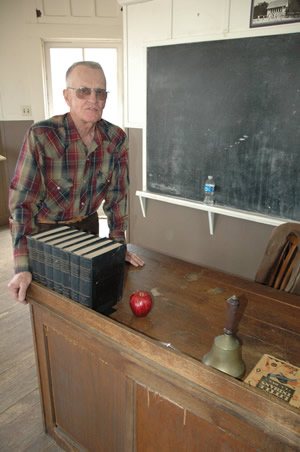
Photo: Charles Feller inside the White Oak school house on the grounds of the Pioneer Museum in Fredericksburg TX
August 10, 2025 - The first day of school will soon bring an end to the carefree days of leisure enjoyed by local children. In earlier times the summer break was no vacation as everyone in the family was needed to plant, tend and harvest crops. School sessions were much shorter in those days, lasting only about eight months out of the year. Instead of a summer vacation children worked along with their parents picking cotton, chopping weeds and tending livestock.
It is significant that the people of Fredericksburg opened the first school in the fall of 1847, a time of great hardship. The majority of the settlers were still living in crude huts struggling to grow enough to feed their families, and yet they had the vision and forethought to open a school. Although living in primitive conditions the German pioneers had a great appreciation of the education, culture and literature many had enjoyed in the old country.
Soon after the construction of the Vereins Kirche was completed in 1847, Mr. John Leyendecker was hired as Fredericksburg’s first teacher. According to Ella Gold’s 1945 thesis, The History of Education in Gillespie County, the Vereins Kirche had no floor or ceiling and the furnishings consisted of crude benches. From sixty to seventy students were under the tutelage of a single teacher. Assorted books garnered by the students who brought them from home served as text books.
The teacher’s salary was funded by tuition of one dollar per quarter. Given the existing conditions, it is not surprising that teachers did not stay in the position for long. A succession of teachers came and went over the first five years including John Leyendecker, Jacob Brodbeck, Rev. Burchard Dangers and Heinrich Ochs.
Religious education was desired by some families so several parochial schools were opened early in the life of the community. Shortly after the founding of Zion Evangelical Lutheran Church in 1852 the congregation established a school which was first conducted in the parsonage. A Catholic school was organized in 1856 with Franz Stein as the teacher. In 1857 a crop failure forced the school to close and Franz Stein went to teach at the Verein school. When the Catholic school reopened in 1858 Christian Kraus was hired as teacher.
In 1854 the state legislature established the public school system and the county court created five school districts within Gillespie County. In the ensuing years the county court also set aside tuition monies for the “children of widows, insolvents, and orphans.” With state funds came the requirement that instruction be delivered in the English language. By this time several one-room country schools had been opened in the small farming communities that dotted the county. Eventually forty-four one room schools served students in the rural areas of Gillespie County.
In 1856 Fredericksburg opened a public school with August Siemering serving as the teacher. Education was disrupted during the dark days of the Civil War as Siemering joined the army and Stein returned to the Catholic school. They were succeeded by Louis Schuetze. Citizens were saddened and outraged when Schuetze was forced from his home one night and hanged by renegade Confederates for the “crime” of expressing Union sympathies.
By 1870 four teachers were employed and a four grade school was established with each teacher assigned to a different subject area. Due to a shortage of space the school was located in four different buildings on or near the Market Square.
Fredericksburg also boasted a college in two different eras. Founded by the German Methodist Church, Fredericksburg College opened in 1876. Both boarding students and the children of local families attended the college and many went on to become prominent members of the community. When the college closed in 1884 the property was sold to the Fredericksburg school district.
A second college, St. Anthony’s College, operated from 1909 to 1923. The college offered a commercial or business course for young men. Women were briefly admitted in 1918 to a “civil service school for stenographers and typists” at St. Anthony’s. The college closed when St. Mary’s High School added a commercial course of study.
Acquisition of the college property in 1884 allowed the public school to bring all of the students together in a central location on what is now College Street. The old college building is still in use today on the middle school campus. Local educator Eugen M. Bittner wrote in the 1936 FHS Mesa yearbook that when he came to Fredericksburg in 1892 “there was only one building with four rooms and four teachers had to do all the work.” He did not state the enrollment figures.
A number of the early pioneers were university educated and one of these, Dr. Wilhelm Keidel, sent his fourteen year-old son, Albert, back to Germany to study medicine in 1866. This would not have been possible for most families and, in fact, many students were limited by their circumstances to a grade school education in the first decades of the settlement.
A commonly heard expression, “Erste Tod, Zweite Not, Dritte Brot” sums up the lot of the brave pioneers who settled Fredericksburg. Literally translated it means first death, second deprivation, third bread. This statement made reference to the fact that many among the first generation of settlers died prematurely as a result of disease and the primitive living conditions. Their children, the second generation, suffered from hardship and deprivation. But the third generation had bread meaning that opportunity and prosperity had been wrested from the wilderness. This third generation reaped the rewards of the sacrifice and labor of the first two generations and among the rewards was the opportunity to advance their education.
With more prosperous times in Fredericksburg, families sent their children away to college as early as the first decade of the 1900’s. Some progressive families sent the daughters to college as well as the sons. Early college graduates from Fredericksburg noted in Pioneer’s in God’s Hills, Volumes I and II include:
Emil Sauer, University of Texas (Literature) 1903 and M.A. Harvard University 1907
Julia Estill, University of Texas, M. A. 1905
H.H. Sagebiel, University of Texas (Law) 1907
Hugo Kallenberg, University of Texas (Pharmacy) 1909
Edward Krauskopf, Texas A&M College (Civil Engineering) 1911
Louis Jordan, University of Texas (Electrical Engineering) 1915
Note: Much of the information in this article was gathered from Ella Gold’s thesis, The History of Education in Gillespie County, published in 1945.
Children’s Games and Toys
by Liz Brookshire
Play is an important part of a child’s growth and development. Through play, children explore adult roles and learn valuable social skills while exercising the body and imagination. Pioneer children made their own toys since manufactured ones were rarely available. Often scavenged and found items were repurposed to create interesting playthings.
With imagination, an old broom became a stick horse. Hoops were salvaged from worn out barrels and rolled with a forked stick. Boys could carve a slingshot or make a “bull roarer” with a bit of string and a smooth piece of wood or the top of a Prince Albert can. Marbles were fashioned with clay. A button from a worn out garment found in mother’s sewing basket and a length of her crochet thread made a whirligig or “buzz saw.”
Although children were expected to do chores and work alongside the adults pioneer parents also encouraged play by providing simple homemade toys for their children. Mothers created dolls for their daughters using cornhusks, clothespins or handkerchiefs. Some made rag dolls stuffed with cotton and embellished with embroidered faces and yarn hair. Fathers often built simple doll beds or other miniature furniture of scrap lumber or wooden cigar boxes.
Typical games of the school yard included Andy over, red rover, flying Dutchman, drop the handkerchief, baseball, kick the can, tug o’ war, Mother may I, pop the whip, hop scotch, and London Bridge. Local historian Julia Estill, recorded a game called “Esel-Lass-Dich-Hoeren” which is loosely translated as “Donkey, let us hear you bray.” I often use a variation of this game in children’s programming. The child designated as “it” must bray loudly or make other animal sounds. Participants are to keep from smiling or laughing and the first to break into a smile, giggle or laugh then becomes “it.”
Sure seems like more fun than your average video game!
Barbershop & Bathhouse: A Dusty Traveler’s One Stop Shop
by Natasha Grau, Curator of Collections
Need a haircut, a shave, and a hot, sudsy bath? The Arhelger Bathhouse, located on the Pioneer Museum grounds, once sat behind the Arhelger Barbershop on East Main Street. Between 1910 and 1930, Alexander (Alex) Arhelger operated the shop, serving travelers and locals alike.
The bathhouse has served for years as an exhibit room, highlighting a treasured tool collection, and miniature train exhibit. Once in a while a bathhouse needs some grooming itself. Updates are currently being made to the interior to showcase the house as both bathhouse and barbershop in one. This reinterpretation will give visitors to the museum an idea of what furnishings and paraphernalia would have been found in each, during the early 1900s.
How much do you suppose a haircut and a shave cost in 1920? Around 25 cents!===
Our refurbished “Theo A. Koch” barber chairs came out of the “Loth & Land Barber Shop,” oncelocated at 111 E. Main Street in the Maier Building. Mr. Seekatz first openedthe barber shop in 1912. In 1927 or 1928 the shop was named “Loth and LandBarber Shop,” after Adolph Loth and Erwin Land. Raymond Wilke bought Land’sinterest in the shop. Wilke barbered here for 30 years, 1966–1996. Raymond’swife, Mable Wilke, and their daughter, Raynell Wilke, kindly donated the chairsfor the Arhelger Bathhouse/ Barbershop exhibit.
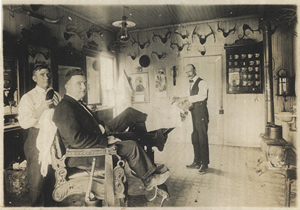
Alexander “Alex” Arhelger’s barbershop, located in the 100 block of East Main Street, 1910-1930
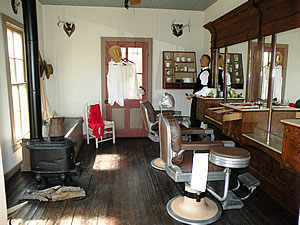
The Arhelger bathhouse, interpreted as bothbathhouse and barbershop, located at the Pioneer Museum
Our sincerest thanks to the following for donating the wonderful materials exhibited in the Arhelger Bathhouse/ Barbershop:
Bill and Vicki Beasley
Richard Bristol
Liz Brookshire
Jeneva Bryans
Buddy and Gladys Frels
Family of Kurt Keidel
Phyllis Ann Keidel-Burkett
Beatrice Klein
Jim Knutson
Jimmie and Linda Langerhans
David and Dee Lawford
Dr. Marie Marschall-Fuller
Glen Treibs
Brent Waldoch
Raymond and Mable Wilke
Fredericksburg and German Easter Traditions
Many Easter customs were brought to America by German immigrants who came to Fredericksburg in the mid-1800s including egg decorating, Easter trees, Easter nests and Easter fires. The Easter rabbit (der Osterhase) as a symbol for Easter is first mentioned in 16th century German literature and the first edible Easter bunnies, made of pastry and sugar, were also produced in Germany in the early 1800s. Around that time, children made nests of grass and hid them in their gardens for the Easter Bunny to fill with brightly decorated eggs. Children in Fredericksburg still build Easter nests today.
The egg tree is a small tree branch put in a vase about two weeks before Easter. Blown eggs that have been painted and decorated are hung from the branches along with other small, highly decorated eggs the family has collected. The hollow eggs are also hung from shrubs and trees during the Easter week.
Easter Sunday was marked by attending church services after which families prepared a special Easter meal. Dessert often included the traditional “lamb cake” baked and decorated to resemble a lamb. The lamb is an important symbol for Easter, representing Christ as the sacrificial Lamb of God. After lunch came the “Ostereiersuchen” or Easter egg hunt.
One Easter tradition with special significance in Fredericksburg is the story of the Easter fires. In the spring of 1847 John O. Meusebach ventured into the wilderness seeking to forge a treaty with the local tribes. Wary Indians watching for signs of treachery camped in the hills surrounding Fredericksburg and the sight of their fires frightened the children. According to local oral history one clever pioneer mother, perhaps recalling Easter fires in the old country, soothed her little ones by telling them that it was only the Easter rabbit dyeing his eggs.
On Easter Saturday in Germany the Easter fires, huge bonfires fueled by the old Christmas trees, are lit and people gather around the fire for schnapps and socializing. The hillsides around villages and towns are dotted with fires as people light their fires at the same time, generally around 9 or 10 pm. The fires clean away the last signs of winter as spring approaches.
According to a posting on the website of the Austrian embassy in Canberra, there are many different interpretations of the meaning of the fires at or around Easter. Some say the fires began as signal fires at the time of Turkish invasions in the 16th and 17th centuries. Others trace them to pre-Christian fires of ritual purification which celebrated the arrival of spring. As with other ancient customs, Christian converts often established a connection to the life of Christ, hence these fires were sometimes referred to as the "burning of Christ’s death-bed". (People used to sleep on a mattress filled with straw which was burned after the person died). In the southern part of the Austrian province of Burgenland, the bonfires are called "bonfires of joy” and are said to celebrate the Resurrection of Christ. These Easter bonfires are often accompanied by the hurling of torches and shooting.
